Get Google Calendar Function by ID
Endpoint used to get Google Calendar functions by ID.
Request Example
Section titled “Request Example”curl --request GET \ --url https://chat.api.toolzz.com.br/api/v1/functions/{functionId} \ --header 'Authorization: Bearer TOKEN_HERE'Response Example
Section titled “Response Example”{ "id": "uuid", "institutionId": "uuid", "userId": "uuid", "unityId": "uuid", "code": "string", "description": "string", "iconFileId": "uuid", "status": true, "name": "string", "pluginIcon": { "id": "uuid", "fileName": "string", "url": "url", "extension": "string", "size": 0 }, "color": "string", "outputs": [], "isActivated": true, "type": "google-calendar", "googleCalendarPlugin": [ { "id": "uuid", "calendarId": "string", "timezone": "string", "googleUser": { "name": "string", "email": "string" }, "googleToken": "string" } ], "discordPlugin": [], "telegramPlugin": []}Request description
Section titled “Request description”Access Token
Section titled “Access Token”| Parameter | Type | Description | Required |
|---|---|---|---|
Authorization | String | Access token (“Bearer” must be before the token) | Yes |
URL Parameters (Path)
Section titled “URL Parameters (Path)”| Parameter | Type | Description | Required |
|---|---|---|---|
functionId | UUID | Unique function identifier. | Yes |
Response description
Section titled “Response description”| Key | Type | Description |
|---|---|---|
id | UUID | Unique identifier of the plugin record in the database. |
institutionId | UUID | Unique identifier of the institution to which the plugin belongs. |
userId | UUID | Unique identifier of the user who performed the configuration. |
unityId | UUID | Unique identifier of the linked organizational unit. |
code | String | Technical reference code for the internal integration logic. |
description | String | Prompt/Instruction: Behavioral rules for the AI when operating the function. |
iconFileId | UUID | Reference identifier of the associated icon file. |
status | Boolean | Defines if the plugin is globally available in the system. |
name | String | Visible name of the plugin (e.g., “Meeting Scheduling”). |
pluginIcon | Object | Detailed data of the icon image file: |
pluginIcon.id | UUID | Unique identifier of the image file. |
pluginIcon.fileName | String | Physical name of the file stored on the server. |
pluginIcon.url | URL | Public link (CDN) for rendering the icon. |
pluginIcon.extension | String | Image file extension (e.g., png, svg). |
pluginIcon.size | Number | Total file size in bytes. |
color | String | Color label for the visual interface (e.g., blue, gray). |
outputs | Array | List of output variables generated by the plugin execution. |
isActivated | Boolean | Indicates if the integration is active and enabled for use. |
type | String | Technical type of the integration (fixed: google-calendar). |
googleCalendarPlugin[] | Array | Configuration of the connected calendar instance: |
...[].id | UUID | Unique identifier of the calendar configuration instance. |
...[].calendarId | String | ID of the target calendar (usually the e-mail or primary). |
...[].timezone | String | Timezone configured for the events (e.g., America/Sao_Paulo). |
...[].googleUser | Object | Identity data of the authenticated Google account: |
...[].googleUser.name | String | User’s full name extracted from the Google profile. |
...[].googleUser.email | String | E-mail address of the linked Google account. |
...[].googleToken | String | OAuth2 access token for communication with the Google API. |
discordPlugin[] | Array | List of Discord extensions (empty if the type is Google Calendar). |
telegramPlugin[] | Array | List of Telegram extensions (empty if the type is Google Calendar). |
Security
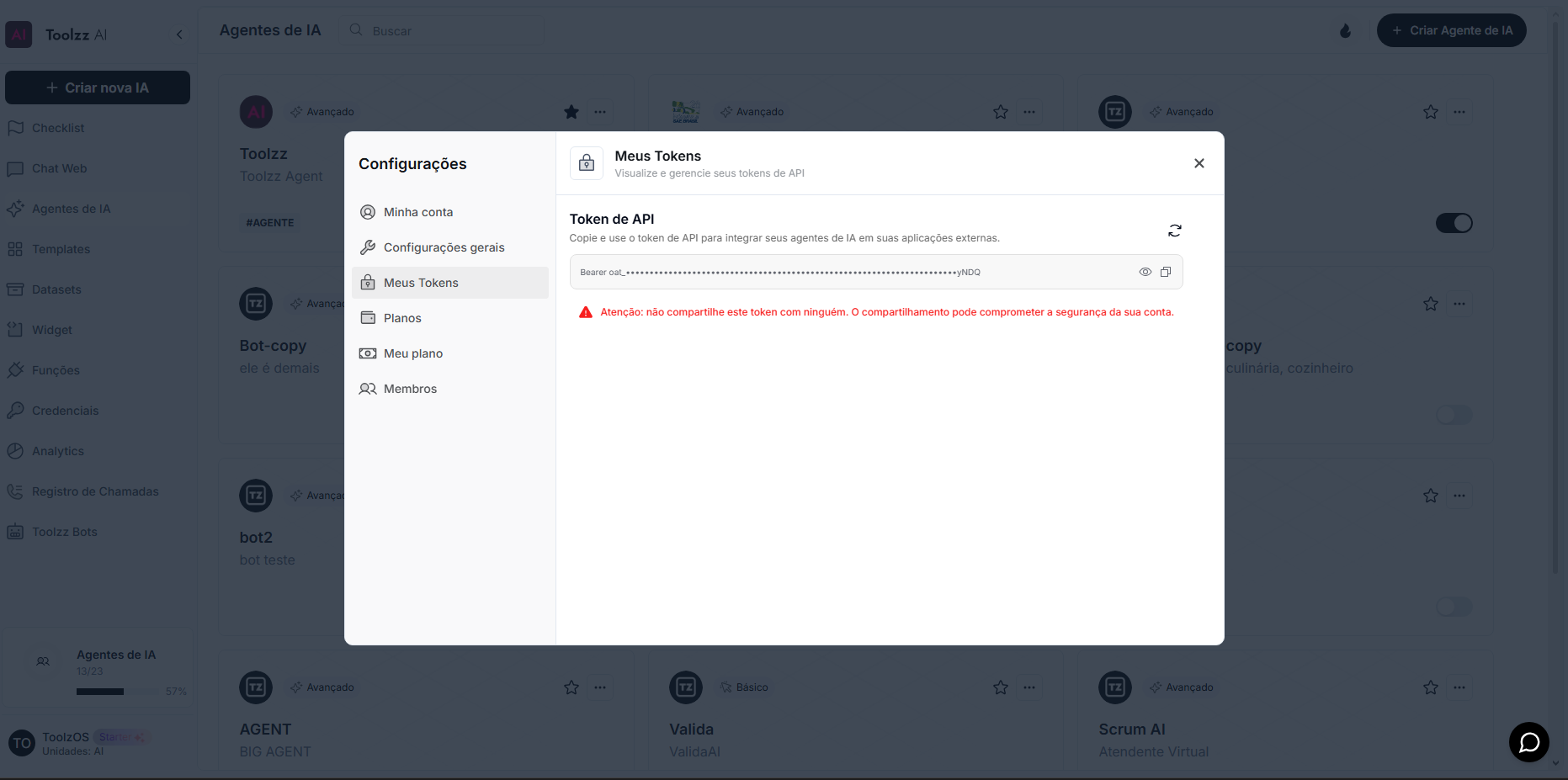
Section titled “Security”To access this endpoint, it is necessary to send a valid access token through the authorization header (Authorization) of the request. Additionally, the API is protected by other security measures to safeguard user data.
To access your access token, follow these steps:
- Log in to the ToolzzAI platform
- Click on “Settings”
- Click on “Access Token”
- Copy the access token