Get Telegram Integration by Unit
Endpoint used to get a Telegram integration by unit.
Request Example
Section titled “Request Example”curl --request GET \ --url https://converflow.api.prod.toolzz.media/api/v1/telegram/integration/unit/{unitId} \ --header 'Authorization: Bearer TOKEN_HERE'Response Example
Section titled “Response Example”{ "data": [ { "id": "uuid", "botId": "uuid", "unitId": "uuid", "title": "<string>", "isActive": true, "botToken": "<string>", "isTokenMasked": true, "scope": "<string>", "welcomeMessage": "<string>", "createdAt": "<timestamp>", "updatedAt": "<timestamp>", "deletedAt": null } ]}Request description
Section titled “Request description”Access Token
Section titled “Access Token”| Parameter | Type | Description | Required |
|---|---|---|---|
Authorization | String | Access token (“Bearer” must be before the token) | Yes |
URL Parameters
Section titled “URL Parameters”| Parameter | Type | Description | Required |
|---|---|---|---|
unitId | String | Unit ID | Yes |
Response description
Section titled “Response description”| Key | Type | Description |
|---|---|---|
data[] | Array | List of objects containing the Telegram integration settings. |
data[].id | UUID | Unique identifier of the configuration in the database. |
data[].botId | UUID | Identifier of the bot associated within the Toolzz AI platform. |
data[].unitId | UUID | Unique identifier of the owning organizational unit. |
data[].title | String | Integration identifier name (e.g., “TelegramAI”). |
data[].isActive | Boolean | Indicates if the Telegram integration is active and operating. |
data[].botToken | String | Authentication token (Bot API Key) masked for security. |
data[].isTokenMasked | Boolean | Confirms if the token returned in the response is hidden. |
data[].scope | String | Bot’s scope of action (e.g., both, private, group). |
data[].welcomeMessage | String | Automatic greeting message for new users. |
data[].createdAt | String | Record creation date and time (ISO 8601). |
data[].updatedAt | String | Date and time of the last configuration modification. |
data[].deletedAt | String/Null | Logical deletion date (Soft Delete), if applicable. |
Security
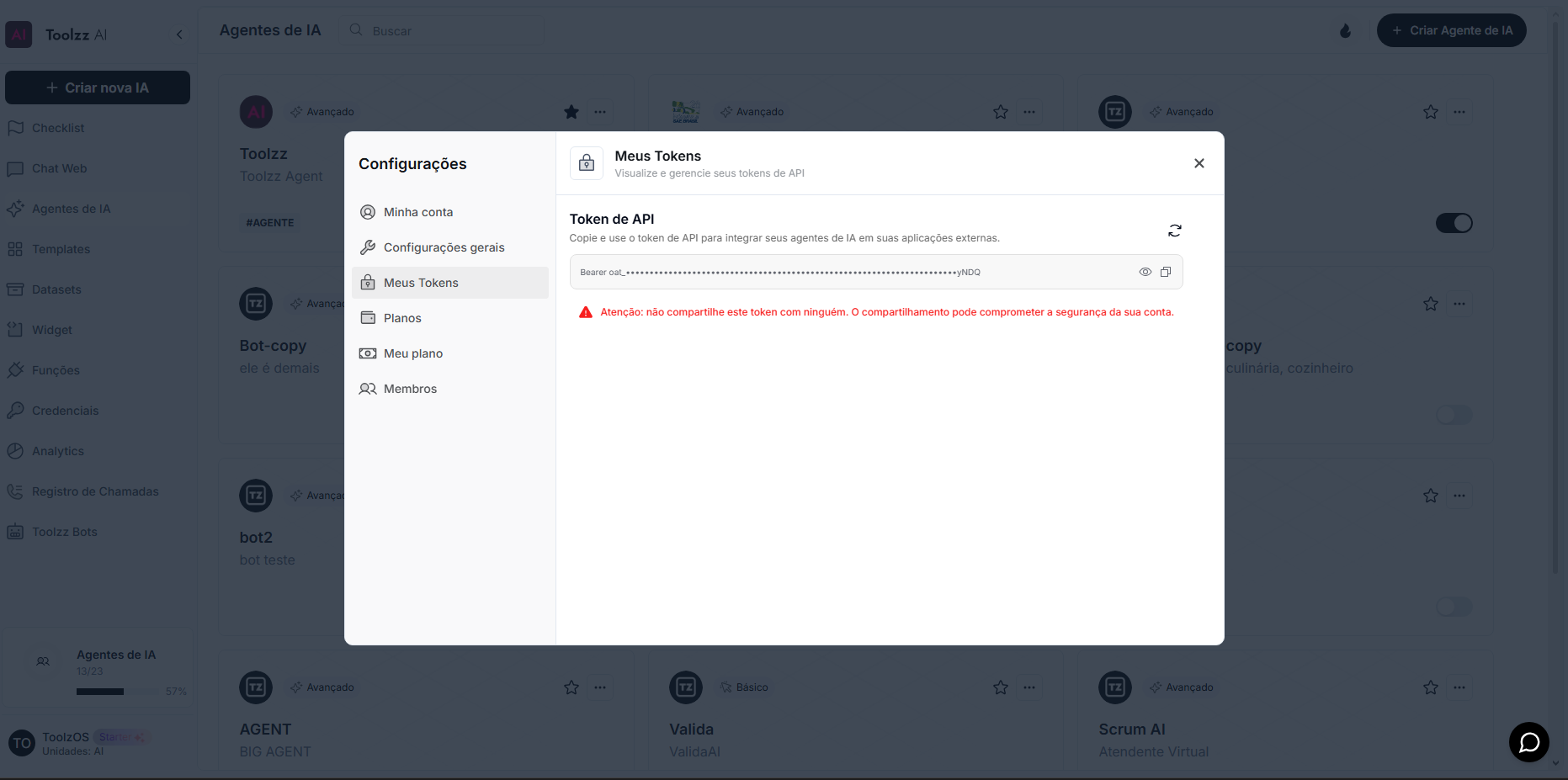
Section titled “Security”To access this endpoint, it is necessary to send a valid access token through the authorization header (Authorization) of the request. Additionally, the API is protected by other security measures to safeguard user data.
To access your access token, follow these steps:
- Log in to the ToolzzAI platform
- Click on “Settings”
- Click on “Access Token”
- Copy the access token