Integrate Slack Bot
Endpoint to integrate a Slack bot into the ToolzzAI agent.
Request Example
Section titled “Request Example”curl --request POST \ --url https://converflow.api.prod.toolzz.media/api/v1/slack/integration \ --header 'Authorization: Bearer TOKEN_HERE' \ --header 'Content-Type: application/json' \ --data '{ "unitId": "uuid", "title": "<string>", "signingSecret": "<full_secret_string>", "botToken": "xoxb-<full_token_string>", "replyOnMention": boolean, "replyInDms": boolean, "threadAutoReply": boolean, "channelIds": [ "<channel_id_string>" ]}'Response Example
Section titled “Response Example”{ "id": "uuid", "botId": null, "unitId": "uuid", "teamId": "T<string>", "title": "<string>", "botToken": "xoxb-<string_masked>", "signingSecret": "<string_masked>", "isActive": true, "isTokenMasked": true, "scope": "all", "channelIds": ["string"], "channelsDetail": [], "defaultChannelId": null, "replyOnMention": true, "replyInDms": true, "threadAutoReply": true, "welcomeMessage": "", "createdAt": "YYYY-MM-DD HH:mm:ss.SSSSSS", "updatedAt": "YYYY-MM-DD HH:mm:ss.SSS", "deletedAt": null}Request description
Section titled “Request description”Access Token
Section titled “Access Token”| Parameter | Type | Description | Required |
|---|---|---|---|
Authorization | String | Access token (“Bearer” must be before the token) | Yes |
Body Parameters
Section titled “Body Parameters”| Parameter | Type | Description | Required |
|---|---|---|---|
unitId | UUID | Unique identifier of the owning organizational unit. | Yes |
title | String | Friendly name to identify the integrated function (e.g., “Slack Integration”). | Yes |
signingSecret | String | Secret Key: Used to verify that requests really come from Slack. | Yes |
botToken | String | OAuth Token (xoxb): Authorization credential for the bot to act in the workspace. | Yes |
replyOnMention | Boolean | If true, the AI only responds when mentioned with @. | Yes |
replyInDms | Boolean | If true, the AI can respond in private Direct Messages. | Yes |
threadAutoReply | Boolean | If true, the AI will respond within conversation threads. | Yes |
channelIds | Array[Str] | List of IDs of the channels where the bot will have permission to act. | Yes |
Response description
Section titled “Response description”| Key | Type | Description | Required |
|---|---|---|---|
id | UUID | Unique identifier of the integration configuration in the system. | Yes |
botId | Null/UUID | Toolzz AI Agent ID: Currently null; needs to be linked to an AI. | No |
unitId | UUID | Unique identifier of the owning organizational unit. | Yes |
teamId | String | Unique identifier of the Workspace (Team) on Slack (e.g., starts with T). | Yes |
title | String | Name assigned to the configuration (e.g., “Slack Bot”). | Yes |
botToken | String | OAuth access token (masked by asterisks). | Yes |
signingSecret | String | Signing secret key (masked by asterisks). | Yes |
isActive | Boolean | Defines if the integration is active and ready to operate. | Yes |
isTokenMasked | Boolean | Confirms that sensitive tokens are hidden in the response. | Yes |
scope | String | Bot’s scope of action (e.g., all). | Yes |
channelIds | Array[Str] | List of IDs of the channels allowed for interaction. | Yes |
channelsDetail | Array | Empty list that can contain extra channel metadata. | No |
defaultChannelId | Null/Str | Main channel for system-triggered messages. | No |
replyOnMention | Boolean | If true, the AI only responds if marked with @. | Yes |
replyInDms | Boolean | If true, the AI responds in private conversations (Direct Messages). | Yes |
threadAutoReply | Boolean | If true, the AI responds within conversation threads (Threads). | Yes |
welcomeMessage | String | Welcome message for new users. | No |
createdAt | String | Exact record creation date and time (ISO 8601). | Yes |
updatedAt | String | Date and time of the last data change. | Yes |
deletedAt | Null | Deletion date (null indicates that the record is active). | No |
Security
Section titled “Security”To access this endpoint, it is necessary to send a valid access token through the authorization header (Authorization) of the request. Additionally, the API is protected by other security measures to safeguard user data.
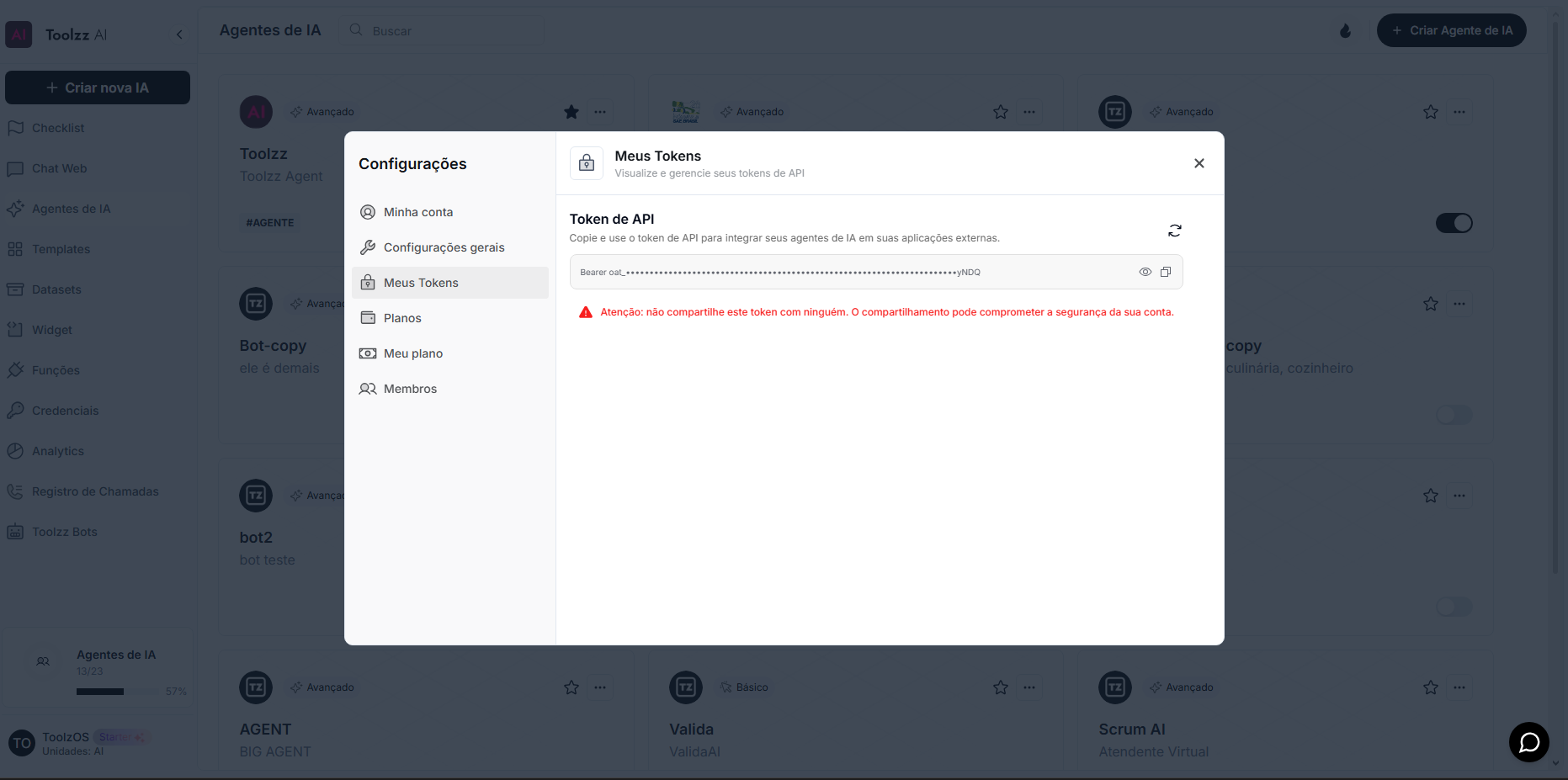
To access your access token, follow these steps:
- Log in to the ToolzzAI platform
- Click on “Settings”
- Click on “Access Token”
- Copy the access token